
Introduction
Short answer: connecting recruitment and onboarding reduces HR hand-offs because the information collected while hiring, such as candidate details, the offer and the agreed role, flows straight into the employee record instead of being re-entered by someone else. Fewer re-entries mean fewer errors, faster joining and a better first week for the new hire.
In many companies the hiring process and the onboarding process belong to different tools and sometimes different people. The recruiter keeps candidate details in a spreadsheet, the offer is a document in an inbox, and when the candidate accepts, HR starts again from scratch: collecting the same details, creating the employee record and setting up access.
This article looks at where those hand-offs happen, what they cost, and how to design a connected hiring-to-onboarding flow.
Where Hand-Offs Happen
Each of these is a point where information is copied from one place to another.
- A job opening is approved in one channel and posted in another.
- Applications arrive by email, job boards and referrals, and must be consolidated by hand.
- Shortlisted candidates move to interviews through manual coordination of calendars.
- Interview feedback is collected over chat and summarised separately.
- The offer letter is drafted from scratch or copied from an old one.
- On acceptance, candidate details are re-keyed into the employee record.
- Documents, bank details and joining tasks are collected over email.
- Access, department and reporting manager are set up in separate steps.
What a Connected Flow Looks Like
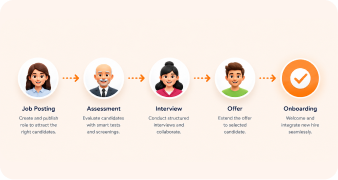
A connected process keeps one record for each candidate from opening to day one.
1. Open and approve the role
Create the opening with its department, location and requirements, and route it for approval so everyone works from the same version.
2. Collect applications in one place
Applications from every source land in a single pipeline, so recruiters screen from one list instead of several inboxes.
3. Screen and assess
Shortlist against the requirements and, where it helps, use a pre-hire assessment to compare candidates more objectively.
4. Schedule interviews and capture feedback
Plan multi-round interviews, notify interviewers and candidates, and record feedback against the candidate so the decision is based on evidence.
5. Generate the offer
Use templates so the offer letter picks up the candidate's details, role and terms, and keep acceptance on record.
6. Convert the candidate to an employee
On acceptance, the candidate's data becomes the employee record, with documents, department and reporting line set up for the joining date.
Disconnected vs Connected Hiring
| Stage | Disconnected | Connected |
|---|---|---|
| Applications | Spread across email and job boards | One pipeline for every source |
| Interviews | Calendar coordination by hand | Scheduled and tracked in the system |
| Feedback | Chat messages and notes | Recorded against each candidate |
| Offer | Drafted from scratch each time | Generated from templates with candidate data |
| Joining | Details re-entered into a new record | Candidate converts to an employee record |
| Reporting | Manual counts | Hiring numbers available on demand |
What You Gain
The benefits show up in speed, accuracy and candidate experience.
- Faster time to hire, because less time is lost to coordination and re-entry.
- Fewer data errors in names, contact details, salary and joining dates.
- A smoother experience for candidates, who are not asked for the same information repeatedly.
- Better decisions, because feedback and assessment results sit with the candidate record.
- Cleaner onboarding, with documents and tasks ready before day one.
- Reliable hiring metrics, such as sources, stages and time per stage.
Onboarding Starts Before Day One
The strongest onboarding begins when the offer is accepted, not on the joining date. Collect documents and details early, assign a reporting manager and department, and prepare the practical items the new hire will need, such as access and a first-week plan.
Exit is part of the same lifecycle. When a single employee record carries the person from candidate to leaver, onboarding and exit flows, document management and profile data all draw on the same source, so nothing needs to be rebuilt at either end.
DASH HR connects job posting, applications, assessments, interview scheduling, feedback and offer letters with employee onboarding and profile management, so a selected candidate can move into the employee record without re-entry.
Metrics Worth Tracking
A connected process makes these measures easy to see. Track a few and review them regularly.
- Time to hire: days from an approved opening to an accepted offer.
- Time in each stage: where candidates wait longest, which shows the bottleneck.
- Source quality: which channels produce candidates who are hired and stay.
- Offer acceptance rate: a sign of how well the process and the offer land.
- Time to productivity: how quickly new hires settle into the role.
- Early attrition: leavers in the first months, which can point to onboarding gaps.
Pitfalls to Avoid
Connecting systems does not fix a weak process. If roles are approved late, interviewers do not give feedback on time or offers wait for sign-off, software will only make the delays more visible. Agree service levels for each stage, such as how quickly feedback is due, and check them regularly.
Also avoid collecting more than you need. Ask candidates for the information required at each stage and gather the rest after acceptance. A long application form loses good candidates, and unnecessary personal data creates a compliance burden for you.
A Simple First-Week Plan
Good onboarding makes the first week predictable for the new hire and for the team.
1. Before day one
Confirm the joining date, send the welcome information and collect any outstanding documents.
2. Day one
Introduce the team, set up access, explain the role and give a short overview of policies and how to use the HR system.
3. First week
Agree early goals with the manager, schedule introductions to key colleagues and give a few small tasks to build confidence.
4. End of week one
Hold a short check-in to answer questions and fix anything missing, such as access or documents.
Key Takeaways
- Every hand-off between tools or people is a chance for delay and error.
- One record per candidate, from opening to joining, removes most re-entry.
- Templates and structured feedback make offers and decisions faster and more consistent.
- Prepare onboarding as soon as the offer is accepted.
- Connected data also gives you reliable hiring metrics.
Connect Hiring and Onboarding in One Place
See how DASH HR takes a candidate from job posting to employee record without re-entry.
Frequently Asked Questions
It is the moment information moves from the recruitment process to HR's onboarding process, such as when an accepted candidate's details are used to create an employee record. Manual handoffs are a common source of delays and errors.
Templates keep the structure and wording consistent and pull in the candidate's details and role, so offers go out faster with fewer mistakes.
In a connected HRMS, yes. The candidate's details carry over when the candidate is selected, and HR adds the remaining joining information.
Signed offer, collected documents, a department and reporting manager, access to the tools they need and a simple first-week plan.
Yes. Small teams feel the cost of re-entry the most because the same person often handles hiring, onboarding and payroll.